Lending Libraries for Hobbies Help You Try Before You Buy
Lending libraries for hobbies let you borrow tools, games, and craft kits before buying, helping you choose an activity that fits your space and interests.
The common mistake with lending libraries for hobbies is choosing a collection by its impressive inventory instead of by the activity you want to try; the cost is a borrowed item that sits unused because it does not fit your space, plans, or experience. Borrowing works best when one kit or tool answers a clear question about a pastime before you commit to owning supplies.
Communities share books, instruments, games, craft supplies, and specialist equipment through public libraries, clubs, schools, and neighborhood groups. Access comes before ownership, but the arrangement varies: some collections lend complete kits for home use, while others provide equipment and workspace on site. The right option depends on what you want to explore and whether you need instruction or company along with the materials.
Borrowing Before Buying
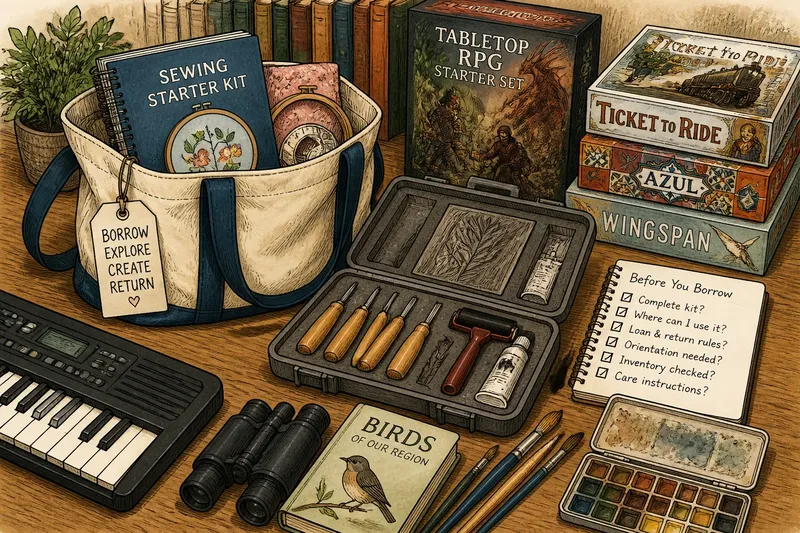
A hobby collection lends the means to do something, not just something to read. You might borrow a sewing machine, a board game, carving tools, a field guide, or a craft kit. Some organizations let you reserve individual pieces; others assemble everything needed for a beginner project.
Instead of asking, “What should I buy?” ask, “What would help me learn whether I enjoy this?” A borrowed keyboard, for instance, could help you discover that you like practicing music but prefer a compact instrument. A shared game collection lets a group try different styles of play before filling a shelf with titles.
Search for the materials that support your first session, not the collection with the longest inventory.
Match Your Situation
If you have little storage, look for complete kits you can return or a shared workspace where bulky equipment stays on site. A community makerspace, for example, may offer tools and worktables for model-making or printmaking without asking you to store them at home.
If you are unsure whether an interest will stick, find a beginner-friendly kit and check its loan terms. Materials grouped by activity can make a first attempt simpler: an embroidery kit might include needles, hoops, and sample cloth, rather than leaving you to assemble supplies without knowing what belongs together.
If you want company, look for a collection connected to a club, library program, or community workshop. A scheduled gathering or a chance to ask a basic question may suit a social pastime better than borrowing an item to use alone.
If you already enjoy an activity but need a specialized tool only occasionally, prioritize clear reservation and return arrangements. A focused lending library may be more useful than a general collection whose inventory is broad but not tailored to your project.
Say you are curious about tabletop role-playing games, and your group has not tried one. You could borrow a starter set from a public library, read its rules together, and use it for an evening session. If the group enjoys the style, you have a reason to borrow another title or buy one; if not, you can return the set without adding a game that no one wants to play.
Check Before Borrowing
- Check whether the item is a complete kit or a single piece; if essential parts are included, reserve it for your planned activity, but if they are missing, ask whether they can be borrowed separately or choose another kit.
- Check where the item can be used; if it is suitable for home use and fits your available space, plan a home session, but if it must stay on site, book workspace or choose a portable alternative.
- Check the loan and reservation rules; if the return date fits your schedule, reserve the item, but if it conflicts with your plans, ask about another loan period or wait for a better time.
- Check whether an orientation is required; if you can attend it before your session, book the orientation, but if you cannot, choose an item that does not require it or ask the organization about another session.
- Check the kit inventory when you collect it; if the listed pieces are present, proceed with your plan, but if something is missing, report it before leaving and request a complete set or a different item.
- Check the handling and cleaning instructions; if they are clear and manageable, follow them during use, but if they are unclear, ask the lending organization before using the item.
Questions About Hobby Libraries?
What can a hobby lending library include?
Collections may include tools, instruments, games, craft supplies, outdoor gear, or instructions paired with materials. Some items can travel home, while others are available only in a shared workspace.
How can I find one nearby?
Search your public library catalog for your interest, along with terms such as “tool library,” “makerspace,” or “seed library.” Community centers, arts organizations, schools, and hobby clubs may also maintain shared collections.
What should I check before borrowing?
Confirm what the loan includes, how reservations and returns work, and whether membership or an orientation is required. For use and care, follow the item’s label and the lending organization’s instructions.
What if I need help using the materials?
Ask whether the collection offers a demonstration, printed instructions, or a beginner gathering. If it does not, choose materials with clear guidance or seek instruction from a suitable instructor before attempting unfamiliar work.
Choose The Right Collection
A public library may make it easy to discover a broad assortment; a specialist club may offer niche equipment and knowledgeable members. A tool library often centers on practical gear, while a makerspace may combine shared tools with worktables and instruction. Decide which part you need most: the object, the workspace, guidance, or company.
Consider whether you can use the loan where you plan to pursue the pastime. Some activities depend on a particular machine or work area, so an item that stays at a workshop may be a better fit than a take-home loan. Portable activities, such as card games or nature observation, may need little more than a kit you can carry.
Ask how the organization handles worn or incomplete sets. Shared materials pass between borrowers, so check the inventory and report missing pieces before you begin. A clear list helps you spot a gap before it interrupts your session.
Imagine you want to try block printing at home but have only a small table and no press. You find a community arts center that lends a beginner kit with carving tools, ink, and a small brayer, while its press stays on site. You check that the kit is complete, reserve a worktable for the press portion, and follow the center’s instructions for handling the tools. The result is a first session that shows whether you enjoy the carving and printing process; the tradeoff is that you need to visit the center for the press rather than complete every part at home.
Make The Loan Count
Before reserving an item, describe your first session plainly: where you will use it, who will join you, and what you hope to learn. Then borrow only what can answer that question. A beginner kit is often more revealing than a large bundle of materials you have not yet learned to use.
When you return the item, note what shaped your experience. You may have liked the social setting but not the equipment, or enjoyed the tool while finding the instructions hard to follow. Those observations can guide a second loan, a workshop visit, or a decision to acquire a few supplies of your own.
Lending libraries for hobbies are most useful when they connect one clear curiosity with materials you can actually use. Before visiting a hobby shop, search for a local collection that lets you try the part of the activity that interests you. The experience can point toward a new pastime—or show you what you can comfortably leave on the shelf.