A Sunday Walk with One Thing to Notice
A Sunday walk with one thing to notice turns an open-ended stroll into a calm, satisfying outing, without a distance target or a packed plan.
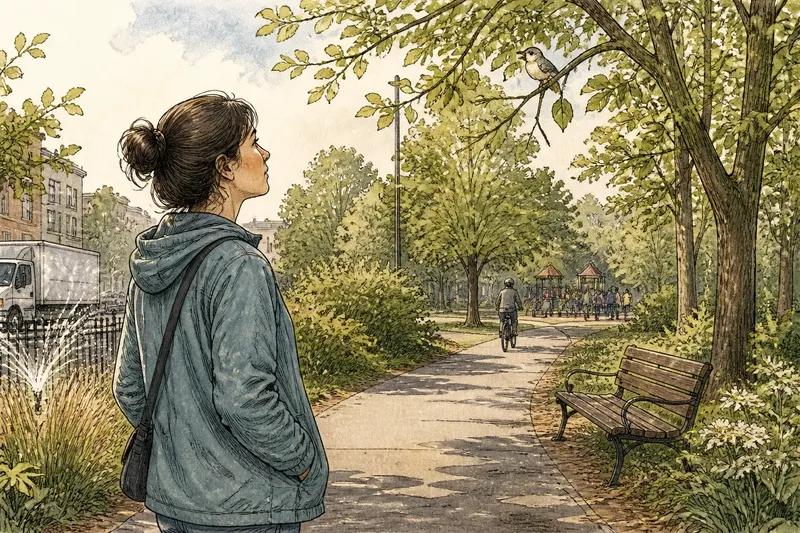
The common mistake on a Sunday walk is to measure its success by how far you went; that can turn a quiet outing into another task, complete with clock-watching and a nagging sense of falling short. A Sunday walk with one thing to notice offers a gentler anchor: choose a detail, such as bird calls or leaf shapes, and let curiosity set the pace.
Imagine that Lena has an open Sunday morning, a neighborhood park nearby, and no appetite for a long hike. She wants to get outside without turning the day into a fitness challenge. For this invented situation, she chooses one focus—sounds—and plans to notice how they change as she moves from the street to the park and back.
A Focus, Not a Route
Lena’s first decision is not where to walk, but what to give her attention. “Sounds” is broad enough to stay interesting and clear enough to guide her eyes and ears. She might hear a bus braking, a gate latch, wind in ornamental grass, or a bird calling from a hedge. None needs to become a project.
A useful focus is easy to notice without special equipment and flexible enough to survive a change in weather or route. Shapes can mean the outline of clouds, rooflines, seed heads, or shadows. Seasonal signs might be fallen blossoms, bare twigs, fresh buds, or the feel of a cooler breeze. Choose one theme, not a scavenger hunt with a dozen demands.
Lena leaves her phone in her pocket and does not pick a destination. She knows the park has a paved entrance and a quieter path beside a line of trees, but she will decide where to turn once she is outside. That small amount of familiarity makes the outing feel manageable without fixing its length.
Pick a focus you can notice from a comfortable walking pace.
Starting at the Door
Before leaving, Lena checks the weather and puts on shoes suited to the surfaces she expects. She takes a light layer because the morning may feel different in shade than it does on her front step. She does not need a special notebook, camera, or nature app. If she wants to remember something, she can hold it in mind or make a brief note afterward.
At the door, she gives herself a simple intention: listen for sounds that change as the surroundings change. It is not a promise to identify every bird or distinguish every engine. The difference matters. Identification turns a casual walk into a quiz; listening leaves room for ordinary sounds to be enough.
She starts along the familiar sidewalk. A delivery truck rumbles away, then a sprinkler ticks behind a fence. At the park entrance, the traffic softens, but it does not vanish. Lena notices that the soundscape is layered: nearby footsteps, distant vehicles, leaves brushing together. She does not stop to record each one.
A pause is useful when it happens naturally. Lena waits beside a bench while a cyclist passes, then continues. She has no pace to recover and no planned distance to make up.
Letting Attention Wander
Once inside the park, Lena follows the path beside the trees. The sounds become less predictable. A dog shakes its collar; a child calls from the playground; a bird gives two sharp notes from somewhere above the path. She cannot see the bird, and that is fine. The purpose is noticing, not collecting proof.
Her focus can include contrasts. Is a sound close or far away? Does it stop when she stops? Is it steady, like a fan, or brief, like a twig snapping underfoot? These questions sharpen attention without demanding an answer. A sound may remain mysterious, and the walk still works.
Say the playground grows noisy just as Lena reaches the trees. In this invented situation, she turns down a quieter side path rather than trying to hear through the commotion. The expected result is simply a change in what she can notice: less shouting, more breeze and footfall. If the quiet path is muddy or uncomfortable, she can return to the paved loop instead. Changing course is part of the outing, not a failure of the plan.
The same principle works for other themes. A walker noticing shapes might look at the hard angles of a fence against rounded clouds, then leave the clouds behind as the path enters a tunnel of branches. Someone noticing seasonal signs could spot a patch of new growth and move on without deciding what species it is. The theme guides attention; it does not dictate every turn.
Keeping the Walk Easy
An unhurried walk does not mean ignoring comfort. Lena keeps to paths that suit her shoes and energy, leaves room for other park users, and turns back when she feels ready. If a route is unfamiliar, she can choose a well-used public path and tell someone where she expects to be. These are ordinary adjustments, not rules that need to dominate the morning.
There is no need to silence every distraction. A message can wait if it is not urgent; a sudden shower may send Lena home; a crowded path may make another route more pleasant. Her one focus is an invitation to look and listen, not a test she has to pass regardless of conditions.
She also avoids turning the theme into a tally. Counting every call would pull her toward completion. Instead, she notices a few sounds distinctly and lets the rest become background. The difference is subtle but practical: an open-ended focus can continue or end whenever she chooses.
If you do want a small memento, keep it light. A single note such as “wind in the tall grass near the entrance” captures a detail without requiring a full field journal. A photo can serve the same purpose when taking one does not interrupt your attention or distract from the path.
When the Plan Changes
Imagine Lena finds the park busier than expected and cannot settle into listening. In this hypothetical situation, she does not insist on completing her planned route. She walks one quiet block along a residential street, notices the scrape of a broom on a porch and the clink of a gate, then heads home. The observable result is a short outing with a few distinct sounds remembered—not a certain duration or a required achievement.
On another Sunday, the weather might make her original focus less appealing. If she planned to notice seasonal details but the rain is heavy, she could choose a covered path where puddles, dripping gutters, and wet pavement offer another kind of observation. Or she can postpone the walk. Flexibility keeps the activity restorative rather than making the forecast an obstacle to defeat.
When an access need, health concern, or local restriction affects where you can walk, choose a route and pace that suit your circumstances; a qualified professional can advise on individual health questions. For route conditions and park access, check local information rather than assuming every path is open or suitable.
What Makes It Work?
How do I choose one thing to notice?
Choose something present in your likely surroundings, such as sounds, shadows, textures, or signs of the season. Keep the theme broad enough for variety and simple enough to remember without checking a list.
What if I notice something else?
Let it register, then return to your chosen focus if you feel like it. The theme is a gentle prompt, not a restriction on what you are allowed to enjoy.
Do I need to plan a route?
A familiar starting point and a few comfortable path options may be enough. You can turn back, take a quieter branch, or end the walk when it feels complete.
Should I bring a camera or notebook?
Neither is necessary. Bring one only if it helps you remember a detail and does not make the walk feel like an assignment.
Coming Back Lightly
At home, Lena remembers the shift from traffic to wind, the brief collar jingle, and the bird call she never identified. She does not judge the walk by how much ground she covered or how many sounds she collected. The useful result is that she can recall a few moments from an ordinary morning.
A Sunday walk with one thing to notice can stay small on purpose. Choose a theme, begin somewhere comfortable, and let the surroundings offer what they offer. If you want to repeat the idea, keep the same focus for a few walks or choose a new one next time; either way, leave the distance goal out of it.